

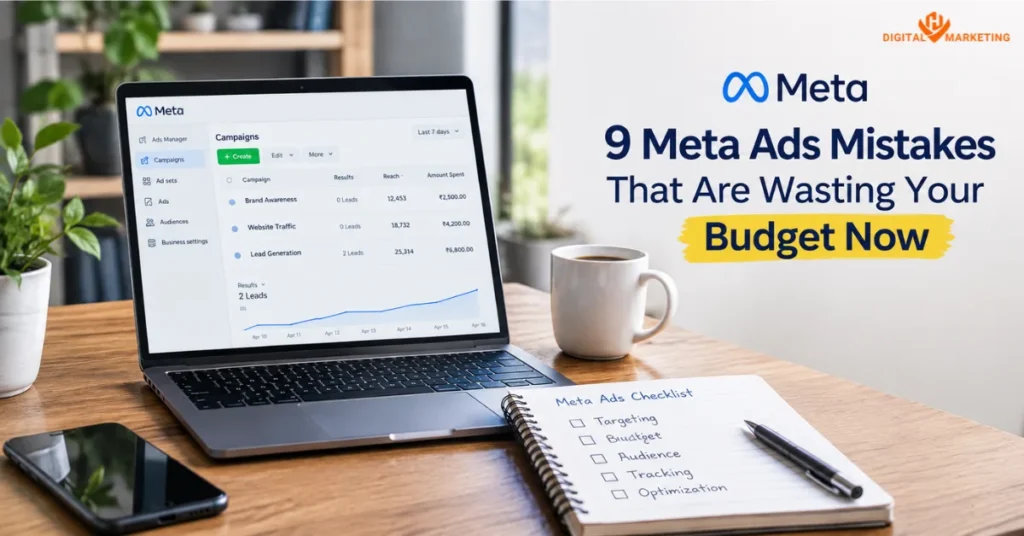
A client came to us this spring having already spent close to ₹3 lakh on Facebook and Instagram ads with almost nothing to show for it. Good click-through rate. Decent reach. Almost zero leads. That’s the pattern behind most of the Meta Ads mistakes we see: the ads aren’t broken, the process around them is.
I’m Hardik Vaghani, founder of HV Digital Marketing. We audit Meta Ads accounts every week, and the same handful of Meta Ads mistakes show up over and over, regardless of the industry. Real estate, home services, e-commerce, doesn’t matter. Nine mistakes account for almost every underperforming account we’ve opened.
The Short Version
The most common Meta Ads mistakes are broad or careless targeting, weak creative, judging a campaign too early, and letting leads sit unanswered. None of these are complicated to fix. Most take an afternoon, not a rebuild. This guide walks through all nine, in the order they usually get found during an audit.
Common PPC Mistakes Aren’t Unique to Meta, But They Hit Harder Here
Here’s the thing about common PPC mistakes on Meta specifically: the platform punishes sloppy setup faster than Google Search does, because Meta is guessing at interest instead of matching intent. A mediocre Google ad still shows up when someone searches the exact phrase. A mediocre Meta ad has to earn attention in a feed full of things people actually wanted to see. That gap is why so many of these mistakes go unnoticed until the budget’s already gone.
Nobody Budgets for Ads That Don’t Convert
You didn’t set aside ₹50,000 or $2,000 a month to “test the platform.” You set it aside to get customers. So when the dashboard shows spend going out and almost nothing coming back, it doesn’t feel like a marketing problem. It feels like money disappearing.
Most business owners in this spot ask the same question: is Meta Ads broken, or is it just not for my business? Almost never either. It’s one or two fixable things, hiding in plain sight.
The 9 Meta Ads Mistakes We See Most Often
Mistake 1: Targeting Too Broad (or Too Narrow)
Audiences that are too broad waste spend on people who were never going to buy. Audiences that are too narrow starve the algorithm of the data it needs to find more of the right people. We had one client insisting on a 2km radius around a single store location, “for accuracy.” Two weeks in, the ad set hadn’t left the learning phase. It never would have, at that budget.
The fix isn’t a magic audience size. It’s matching audience size to budget. A ₹500/day budget can’t feed a targeting radius meant for a national brand, and a ₹500/day budget spread across 10 million people will just get eaten by impressions nobody converts on.
Mistake 2: Weak or Generic Ad Creative
Why polished, brand-heavy ads underperform
Polished ads with studio lighting and brand colors routinely lose to something that looks like it was shot on a phone. It sounds backwards. It isn’t. A feed is full of friends and family content, and a glossy ad reads as an ad before anyone processes what it’s selling. That’s a half-second of resistance you don’t need.
What scroll-stopping creative actually looks like
The best-performing creative we’ve run for clients this year has one thing in common: it states the offer in the first two seconds, on-screen, in text. No cinematic build-up. “Free duct cleaning this week, Surat only” beats a thirty-second brand story every time we’ve tested it.
Mistake 3: No Clear, Single Offer Per Ad
Ads that try to promote a discount, a new product, and a referral bonus all at once confuse both Meta’s algorithm and the person scrolling past it. One ad, one offer, one action. If you have three things to promote, that’s three ad sets, not one crowded one.
Mistake 4: Turning Off Campaigns Too Early
Understanding the learning phase
Every new ad set goes through a learning phase where Meta is still figuring out who to show it to. Performance during this window is genuinely unreliable, and judging a campaign here almost always means killing something that would have worked. According to Meta’s own guidance on ad delivery, an ad set typically needs around 50 conversion events before it exits learning and delivery stabilizes.
How long to wait before judging performance
Give a new campaign at least 3 to 5 days, and don’t touch anything major in that window. Small copy tweaks are fine. Rebuilding the audience is not.
Mistake 5: Ignoring Leads After They Come In
This is the one that quietly costs the most, and it’s rarely the ad’s fault. A lead comes in through a Meta lead form, sits in an inbox for six hours, and by the time someone calls, that person has already filled out three other forms and picked whoever answered first. Slow follow-up turns a working campaign into what looks like a broken one on the dashboard.
Mistake 6: Not Tracking the Right Metrics
Optimizing for clicks or engagement instead of leads and sales is one of the fastest ways to burn budget while the report looks fine. We’ve seen accounts with a 4% click-through rate and zero actual customers, because the campaign objective was set to “traffic” instead of “leads” from day one. The metric you optimize for is the metric Meta will chase, so if you’re chasing the wrong one, the whole account follows.
Mistake 7: Letting Creative Fatigue Set In
An ad that worked in week one can quietly stop working by week four, not because the offer changed, but because the same 2,000 people have now seen it eleven times. Frequency creeping past 3 to 4 on a small, retargeting-heavy audience is the clearest early sign. The fix is boring but it works: rotate in two or three fresh creative variations every couple of weeks, even small edits, before performance actually drops.
Mistake 8: Skipping Retargeting Entirely
Most people don’t convert on the first ad they see. Running only cold, top-of-funnel campaigns and never building a retargeting layer for people who visited the site or engaged with a post leaves easy, cheaper conversions on the table. A retargeting audience built from the last 30 to 90 days of website visitors is usually the single highest-ROI ad set in an account, and it’s often missing entirely.
Meta Ad Mistakes Worth Fixing Before You Add Budget: Weak Conversion Tracking
Mistake 9: Weak or Missing Conversion Tracking
If the Meta Pixel isn’t firing correctly, or events like “Lead” and “Purchase” aren’t set up, Meta is optimizing half-blind. It’ll keep spending, it just won’t know which clicks actually turned into business. We’ve opened accounts where the pixel had been broken for two months and nobody noticed until the cost per lead had quietly doubled.
| Common Mistake | Quick Fix |
|---|---|
| Targeting too broad or too narrow | Size the audience to match daily budget |
| Weak, brand-heavy creative | Lead with the offer in the first 2 seconds |
| Multiple offers in one ad | Split into separate, single-offer ad sets |
| Judging too early | Wait 3–5 days minimum, let learning phase finish |
| Slow lead follow-up | Respond within the hour, ideally minutes |
| Wrong campaign objective | Optimize for leads or sales, not clicks |
| Creative fatigue | Refresh creative every 2–3 weeks |
| No retargeting | Build a 30–90 day website-visitor audience |
| Broken or missing pixel events | Check Events Manager monthly |
What Actually Happened With a Home Services Client
Say you’re running a home services business doing about ₹8 lakh a month in revenue, similar to a client we picked up in early 2026. Their account had decent reach and a 2.1% CTR, but only three leads in six weeks on a ₹40,000 spend. The campaign objective was set to “engagement,” the pixel hadn’t fired a single “Lead” event in over a month, and every lead form submission sat unanswered for an average of nine hours before anyone called back.
We didn’t touch the creative first. We fixed conversion tracking, switched the objective to leads, and set up an auto-reply plus a same-hour call target for the sales team. That’s it, for the first two weeks. Cost per lead dropped from roughly ₹3,800 to ₹1,650, and lead volume nearly tripled the following month. The ads hadn’t changed. The mistakes around them had.
I’ll be honest: creative usually gets blamed first, and it’s usually not the actual problem. In my experience, tracking and follow-up fix more accounts than a full creative overhaul ever does.
Fixing These Facebook Ads Mistakes Before They Drain Your Budget
If you only have an hour this week, spend it on three things: check that your Pixel is firing correctly in Events Manager, confirm your campaign objective actually matches what you want (leads, not traffic), and time how long it takes your team to call a new lead. Those three checks catch roughly 70% of what we find in a typical audit.
According to WordStream’s 2026 Meta Ads benchmark data, the average Facebook lead-generation campaign converts at around 7.72%, with a cross-industry click-through rate near 2.59% for lead-gen objectives. If your account is sitting well below either number, it’s worth checking these nine mistakes before assuming the platform, or your industry, is the problem. We’ve written more about setting up Meta Ads for lead generation the right way from the start if you’re building a new campaign rather than fixing an existing one.
How to Avoid These Meta Ad Mistakes Going Forward
- Audit conversion tracking monthly, not just at launch.
- Keep one offer per ad, always.
- Let every new ad set run at least 3 to 5 days before judging it.
- Route leads to a person who calls within the hour, not the day.
- Refresh creative every 2 to 3 weeks to stay ahead of fatigue.
The result is an account that spends the same budget and produces noticeably more leads, without anyone touching the targeting.
The Short Version, Revisited: Why Are My Facebook Ads Not Converting?
If you’ve made it this far wondering specifically why are my facebook ads not converting, it’s almost never one dramatic thing. It’s usually two or three of the nine above, stacked on top of each other. Fix the tracking first. Everything else gets easier to diagnose once you can actually see what’s happening.
Frequently Asked Questions
Q: Why are my Meta Ads not converting?
A: Most of the time it’s broad targeting, weak creative, or slow follow-up once leads come in, not the platform itself.
Q: How long should I wait before judging a Meta Ads campaign?
A: Give it at least 3 to 5 days in the learning phase before making any major changes.
Q: Should I change my Meta Ads every few days if they’re not working?
A: No. Constant edits reset the learning phase and keep the algorithm from ever stabilizing.
Q: Why is my cost per lead going up on Meta Ads?
A: Usually audience fatigue or rising competition in your niche. Refreshing creative and adjusting targeting is the first move, not increasing budget.
Q: Is it a mistake to promote multiple offers in one ad?
A: Yes, it’s one of the more common Meta Ads mistakes we catch in audits. Split multiple offers into separate ad sets.
Q: How much should I test at once in a Meta Ads campaign?
A: One variable at a time, creative or audience or offer, so you actually know what moved the number.
Q: Does slow lead follow-up really affect Meta Ads performance?
A: Yes. Leads contacted within minutes convert at far higher rates than leads contacted hours later, which can make a genuinely good campaign look broken.
Q: What’s a good conversion rate for Meta Ads in 2026?
A: Around 7 to 8% is average for lead-generation campaigns industry-wide, though it varies a lot by sector, so compare against your own past performance too.
Most Accounts Have One or Two Fixable Problems, Not a Broken Strategy
Most underperforming Meta Ads accounts we open have one or two fixable Meta Ads mistakes sitting in plain sight, not a strategy that needs rebuilding from zero. An audit usually finds them inside an hour.
You can also read our breakdown of affordable SEO services for small businesses if paid ads are only part of your growth plan, and check out HV Digital Marketing’s services if you’d rather have someone else run the audit.
Get a Free Meta Ads Audit tell us your Full Name, Business, Website, and Monthly Ad Spend, and we’ll tell you exactly which of these nine mistakes, if any, are costing you money.

Lead Strategist & Founder (HV Digital Marketing)
SEO Expert, Digital Marketing, Google Ads, Meta Ads, LinkedIn Ads, ChatGPT Ads, & Pinterest Ads Expert
As the founder of HV Digital Marketing, Hardik brings a dual focus of technical marketing expertise and creative campaign execution to every client project. Based in Surat, he specializes in building scalable online growth frameworks using Advanced SEO, localized lead generation, and highly targeted paid advertising across Google, Meta, LinkedIn, ChatGPT, and Pinterest.
Having driven success for businesses in highly competitive sectors including real estate, solar, commercial technology, and healthcare Hardik bridges the gap between raw data and creative strategy. He oversees every aspect of the marketing funnel, from keyword research and WordPress optimization to visual asset design and ad spend management, ensuring every campaign is fully optimized for maximum return on investment.
Expertise: SEO | Technical SEO | Google Ads | Meta Ads | LinkedIn Ads | ChatGPT Ads | Pinterest Ads | Content & Campaign Strategy | Graphic & Visual Design | Core Web Vitals | Digital Marketing | Lead Generation | Local SEO