

I hear this question on almost every discovery call: should we start with SEO or Google Ads? Nine times out of ten, the business already spent money on one of them and got frustrated when it didn’t move fast enough.
I’m Hardik, founder of HV Digital Marketing in Surat, and for the last several years I’ve split ad budgets and SEO roadmaps for local businesses here and, increasingly, for service businesses abroad who found us through a Google search rather than a referral.
Here’s the honest, unglamorous answer: SEO vs Google Ads isn’t really a fight between two rivals. It’s a sequencing question. And getting the order wrong is one of the more expensive mistakes I watch business owners make.
The Short Version
If you need leads inside the next few weeks, start with Google Ads. If you can wait three to six months and want a cost-per-lead that keeps dropping instead of staying flat, start putting real effort into SEO right now. Most businesses that get this right eventually run both. They just don’t start both on day one, and that’s the part almost nobody tells you upfront. That’s the whole SEO vs Google Ads decision, stripped of the sales pitch.
Why This Question Even Comes Up in the First Place
Picture this. You’ve got a website. Maybe a friend built it, maybe an agency did. It looks fine. Nobody’s calling.
Someone tells you to “just do SEO.” Someone else tells you Google Ads is faster. A third person says do both. Your budget doesn’t stretch to both, so you pick one, wait a month, see nothing, and conclude digital marketing doesn’t work for your business.
That’s not a marketing failure. That’s a sequencing failure. The two channels solve different problems, and nobody sat down and explained which problem you actually have right now. This is why the SEO vs Google Ads question deserves a real answer instead of a coin flip.
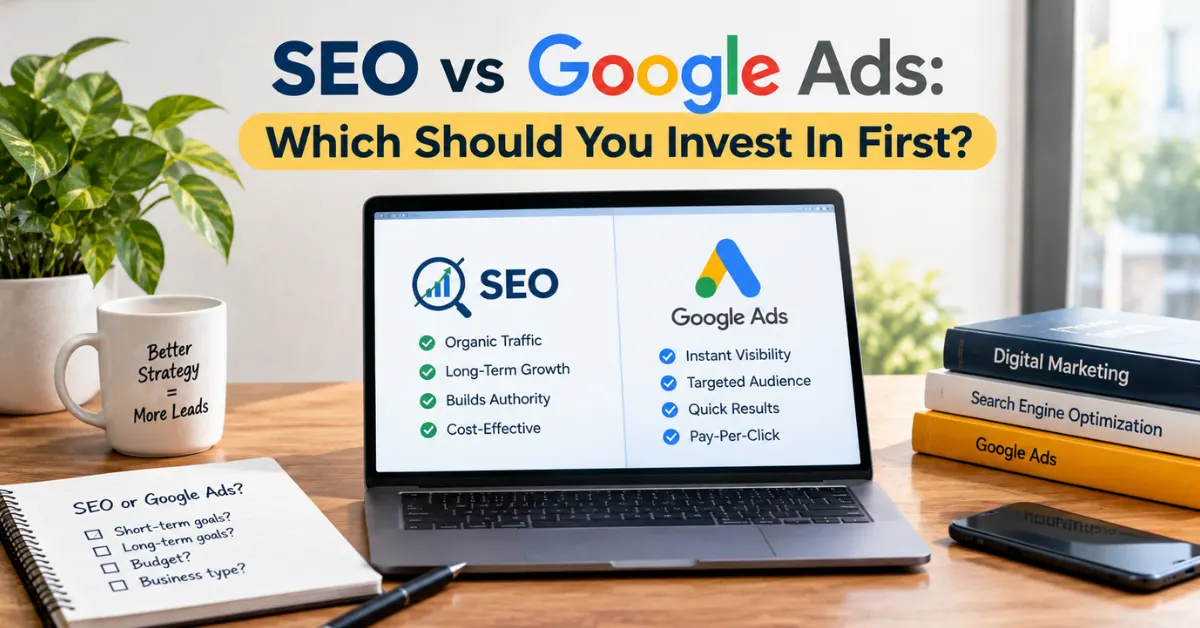
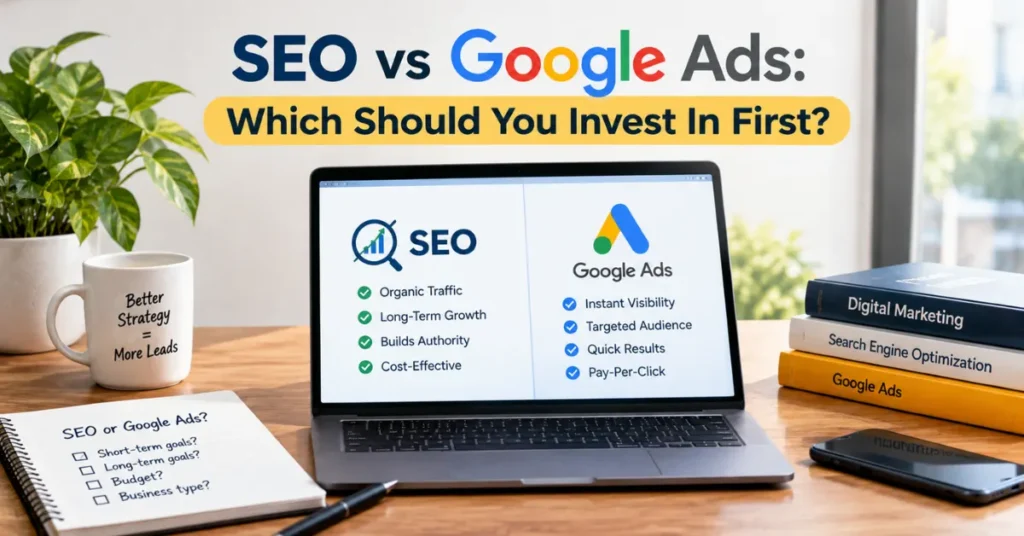
SEO vs Google Ads: The Real Trade-Off You’re Weighing
Direct answer:
Google Ads buys visibility the moment you turn it on and stops the moment you turn it off. SEO takes months to build but keeps generating traffic without ongoing spend once it’s ranking.
Think of Google Ads as renting a storefront on the busiest street in town. Great location, instant foot traffic, and the second you stop paying rent, you’re gone. SEO is more like buying the building. It costs more time upfront, the paperwork is annoying, but nobody can evict you from page one once you’ve earned your spot there.
This is really the entire organic vs paid search debate in one sentence: paid gets you rented visibility, organic builds an asset you own. According to Ahrefs’ compiled SEO statistics, organic search accounts for roughly 53% of all website traffic, compared to about 15% from paid search. That tells you where most of the long-term volume actually lives, even though paid feels louder in the short run.
Neither channel is “better” in a vacuum. The right one depends on what your business needs this quarter versus what it needs next year, and that’s exactly why so many businesses get the SEO vs Google Ads decision backwards.
What Each One Actually Costs, Month by Month
Google Ads costs more upfront and produces leads almost immediately. SEO costs less per lead over time, but it takes months to get there. This is the heart of the SEO vs Google Ads cost debate, and it’s rarely explained honestly.
The First 0–6 Months
Google Ads charges you per click from day one. Search Lab’s 2026 Google Ads benchmark data, compiled from WordStream and LocaliQ research, puts the average cost per click across industries at roughly $2.10, though this swings hard by industry. Legal and insurance sit far above that, while ecommerce sits well below it. Budget-wise, most small businesses I talk to end up spending somewhere between $500 and $3,000 a month to see meaningful volume, and that’s before any management fee.
SEO, in those same six months, usually costs less in raw spend but produces close to nothing in visible traffic. You’re paying for technical fixes, content, and link-building: work that search engines need time to trust. This is the phase where most business owners panic and quit. Don’t. It’s normal.
What a Typical First 90 Days Actually Buys You
If it helps to see this in concrete terms, here’s a realistic SEO vs Google Ads spending breakdown for a service-based business easing into both channels rather than betting everything on one:
- Google Ads (Month 1–3): Account setup, 2–3 tightly targeted campaigns, landing page built for conversion, weekly bid and negative-keyword adjustments. Expect leads within 1–2 weeks, but expect your cost-per-lead to be rough until you’ve collected enough click data to optimise.
- SEO (Month 1–3): Technical audit and fixes, keyword mapping, 4–8 optimised pages or posts published, Google Search Console set up and monitored. Expect little to no ranking movement yet. This is foundation-laying, not results.
Month 12 and Beyond
This is where the SEO vs paid ads for small business math flips. Ads spend stays roughly flat, or climbs, because you’re still paying for every single click, forever. Your SEO cost-per-lead, on the other hand, usually keeps falling, because the pages you built in month one are still ranking and still pulling in traffic without a fresh invoice attached to every visitor.
One industry estimate from Terakeet puts the customer acquisition cost of SEO at up to 87% lower than paid advertising once a site is established, and even if your business lands nowhere near that figure, the direction of the trend is the part that matters.
SEO or PPC: Which One Wins for a Brand-New Website?
A brand-new website with zero rankings and zero traffic history almost always needs Google Ads to generate leads while SEO quietly builds momentum underneath it.
Here’s the blunt version: a website with no age, no backlinks, and no indexed content doesn’t rank for anything competitive in month one, no matter how good the SEO work is. Google simply hasn’t had time to trust it yet. If your business can’t survive three to six months of near-zero organic traffic, SEO or PPC isn’t really a fair fight at this stage. PPC has to carry the business while SEO gets built in the background.
I’ve told new clients this directly, and it’s not always what they want to hear: don’t cancel your ads the moment you hire an SEO agency. Layer them. For a brand-new site, SEO vs Google Ads isn’t really a competition at all. It’s ads now, SEO for later.
What Changes Once Your Site Already Has Some Traffic
An established website with existing rankings and some organic traffic usually gets a stronger return from investing further in SEO, since the foundation is already doing part of the work.
This is the point in the SEO vs Google Ads timeline where the earlier advice stops applying. If your site already ranks for a handful of terms, already has some backlinks, and already gets a trickle of organic visitors, the equation flips. Every additional page you optimise compounds on top of authority you’ve already earned. That same dollar now stretches further in SEO than it does bidding against competitors for the same ad slot.
This doesn’t mean drop your ads. It means your marginal dollar probably does more good in content and technical SEO than in another 200 clicks at rising CPCs. In other words, the SEO vs Google Ads balance should shift as your site matures. It’s not a decision you make once and never revisit.
Running SEO and Google Ads Together (Without Wasting Budget)
SEO builds a durable, ad-independent lead source. Google Ads fills the immediate revenue gap while SEO ramps up, and covers competitive keywords that are painfully slow to rank for organically. Most businesses that grow past a certain size end up needing both.
Here’s roughly how I sequence this for clients who are starting from scratch and don’t have unlimited budget:
- Audit what you already have: Check current rankings, current ad performance if any, and where your competitors already beat you.
- Start Google Ads on your 2–3 highest-intent keywords: Not everything. Just the searches closest to a purchase decision.
- Begin SEO on the same core topics, so the two channels reinforce the same message instead of competing for attention internally.
- Use Google Ads data to sharpen your SEO keyword targets: Ads show you, in weeks, which search terms actually convert. SEO can then chase those same terms with confidence instead of guessing.
- Shift budget gradually as SEO traffic grows, trimming ad spend on the keywords your organic pages have started to win, and redirecting that spend toward gaps SEO hasn’t reached yet.
The result: leads from day one, and a lead cost that keeps improving instead of staying stuck at whatever the auction decided to charge you. Run this way, SEO and Google Ads stop competing for the same budget line and start covering each other’s weak spots instead.
What I’ve Seen Happen With Actual Budgets
I’ll be honest about something most agencies won’t say out loud: I’ve watched business owners get this exact sequencing wrong, and I’ve been the one who had to talk them out of quitting three months in.
A composite example, built from patterns I see repeatedly across home-services and local retail clients: a business launches ads with no landing page strategy, spends for six weeks, gets a handful of low-quality leads, and shuts everything down convinced “digital marketing doesn’t work for us.” Meanwhile their SEO was never touched, so there’s nothing left generating traffic once the ad spend stops. Six months later they’re back at zero, having spent real money to learn nothing except that PPC alone, badly targeted, burns budget fast.
Compare that to a business that split the same monthly budget: a smaller, sharper ad campaign on two or three keywords, plus consistent SEO work on the pages that actually answer what their customers search for. By month four, the ad campaign was still delivering, but the SEO pages had started pulling in free organic leads on top of it.
Same total spend, a very different trajectory by month six. I’m not going to pretend every client hits that outcome on the same timeline. Industries, budgets, and competition all shift the math. but the pattern of “ads alone burn out, SEO alone starts too slow, both together compound” has held up consistently in the accounts I manage. It’s the single clearest real-world argument I’ve got for why the SEO vs Google Ads debate shouldn’t end in picking just one.
SEO vs Google Ads at a Glance
| SEO | Google Ads | |
| Time to first results | 3–6 months | 1–2 weeks |
| Cost structure | Upfront investment, low marginal cost later | Pay per click, ongoing forever |
| Traffic once you stop paying | Continues (with slow decline) | Stops almost immediately |
| Best for | Long-term, sustainable lead flow | Immediate leads, new sites, testing offers |
| Typical cost-per-lead trend | Falls over time | Stays flat or rises with competition |
| Control over messaging | Slower to change, ranks on merit | Instant control, pause or edit anytime |
FAQs
Q. Which is faster, SEO or Google Ads?
A. Google Ads, no contest. In the SEO vs Google Ads speed race, ads win every time. You can be generating leads within days of launching a campaign, while SEO typically needs three to six months before it shows meaningful movement.
Q. How much does Google Ads cost per month for a small business?
A. Most small businesses land somewhere between $500 and $5,000 a month, though it varies enormously by industry. A legal or insurance business will pay far more per click than a home-services business in a smaller city.
Q. Should a new business start with SEO or Google Ads?
A. In most cases, yes. Start with Google Ads for immediate visibility, and build SEO in parallel so you’re not paying for every visitor forever.
Q. Can I run SEO and Google Ads at the same time?
A. You can, and honestly, most established businesses eventually should. Running both means you get immediate leads from ads while SEO builds a channel that doesn’t disappear the moment your budget does.
Q. Does running Google Ads help my SEO rankings?
A. Not directly. Google has been clear that ad spend doesn’t influence organic rankings. What it does help with is data. Ad performance can tell you which keywords actually convert, and that’s useful intelligence for your SEO strategy.
Q. What happens to my traffic if I stop paying for Google Ads?
A. It stops. Almost immediately, in most cases within a day or two. That abrupt drop-off is exactly why SEO matters as a long-term, ad-independent source of traffic.
Q. Which has better ROI, SEO or Google Ads?
A. Over a long enough timeline, SEO usually wins the SEO vs Google Ads ROI comparison because the cost-per-lead keeps falling instead of holding steady. Google Ads wins on speed. You’ll see a return, good or bad, far sooner.
There’s No Wrong Answer, Only the Wrong Order
There’s no universally correct choice in the SEO vs Google Ads debate, only the wrong sequence for where your business happens to be today. A new site with no traffic history needs a different starting point than an established site with some rankings already in place, and a short audit will usually tell you which one your next rupee or dollar should go toward first.
If you want to go deeper on either side of this, we’ve covered affordable SEO services for small businesses and Meta Ads for lead generation as companion reads. If you’re specifically weighing local options, our breakdown of what makes a digital marketing agency in Surat actually deliver results covers a lot of the same ground from a different angle, and our social media marketing services page is worth a look if you’re also weighing organic social into this mix. You can read more about how we work on our about page.
Get a Free Growth Audit. I’ll look at your current SEO and ad setup (or lack of one) and tell you honestly which channel deserves your next rupee first.

Lead Strategist & Founder (HV Digital Marketing)
SEO Expert, Digital Marketing, Google Ads, Meta Ads, LinkedIn Ads, ChatGPT Ads, & Pinterest Ads Expert
As the founder of HV Digital Marketing, Hardik brings a dual focus of technical marketing expertise and creative campaign execution to every client project. Based in Surat, he specializes in building scalable online growth frameworks using Advanced SEO, localized lead generation, and highly targeted paid advertising across Google, Meta, LinkedIn, ChatGPT, and Pinterest.
Having driven success for businesses in highly competitive sectors including real estate, solar, commercial technology, and healthcare Hardik bridges the gap between raw data and creative strategy. He oversees every aspect of the marketing funnel, from keyword research and WordPress optimization to visual asset design and ad spend management, ensuring every campaign is fully optimized for maximum return on investment.
Expertise: SEO | Technical SEO | Google Ads | Meta Ads | LinkedIn Ads | ChatGPT Ads | Pinterest Ads | Content & Campaign Strategy | Graphic & Visual Design | Core Web Vitals | Digital Marketing | Lead Generation | Local SEO