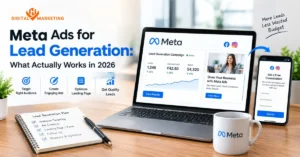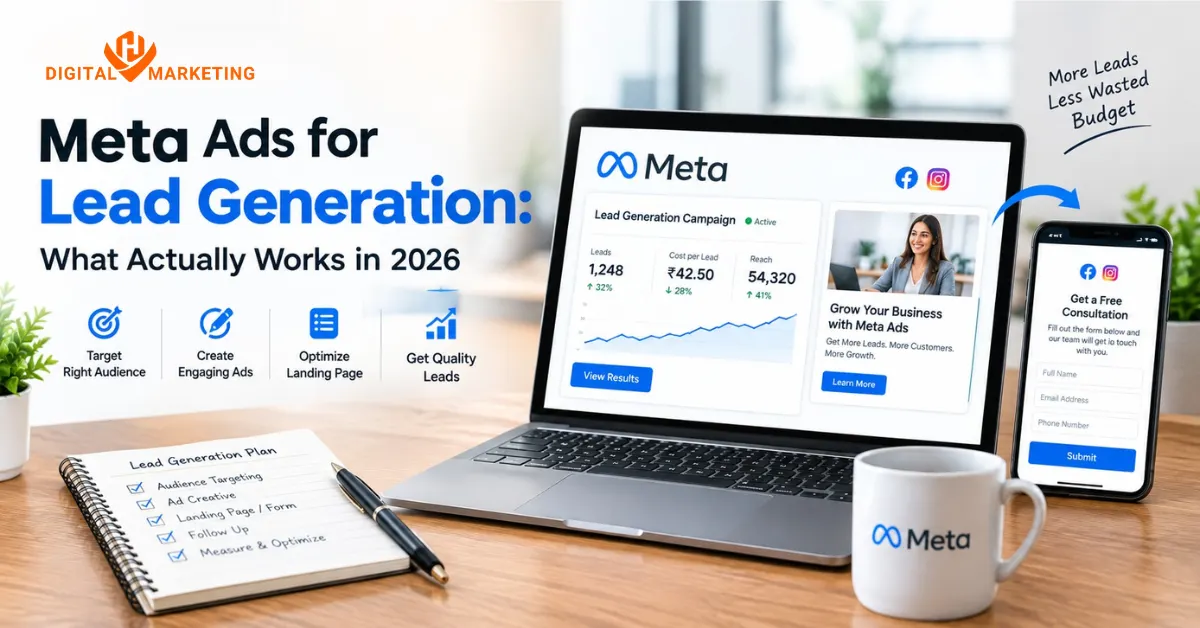


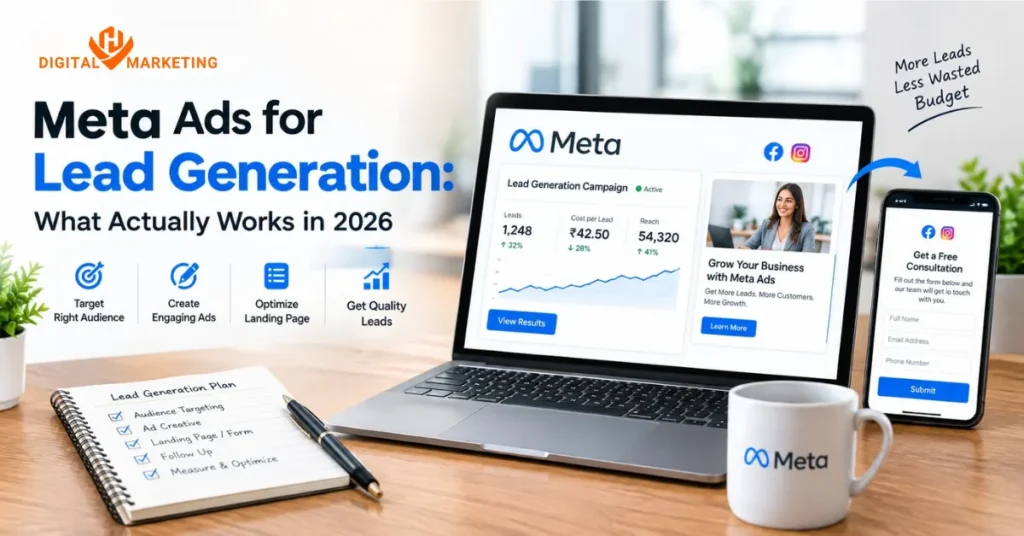
Meta Ads for Lead Generation: What Actually Works in 2026
A client came to us this spring having already spent close to ₹45,000 on Meta Ads with eleven form fills to show for it. Four of those eleven never picked up the phone. That’s the part nobody tells you about meta ads for lead generation: the ad isn’t the hard part anymore. The algorithm finds people fine. What breaks is everything that happens after someone taps submit.
At HV Digital Marketing, we run meta ads for lead generation campaigns for local and service-based businesses across India, the UK, and the US, and this pattern shows up on almost every account we audit before we start. Meta reaches people who weren’t actively searching for you, so the ad, the form, and the follow-up all have to carry more weight than they would on Google. Get that chain right and Meta becomes one of the cheapest, fastest lead sources available. Get it wrong and you’re just paying to feel busy.
The Short Version
Meta ads for lead generation work best when tight audience targeting, scroll-stopping creative, and a low-friction way to convert (either a Meta Lead Form or a fast landing page) all work together. Skip any one of those three and cost per lead climbs while quality drops. The businesses that treat Meta differently from Google, faster creative cycles, faster follow-up, and patience through the learning phase, are the ones that turn it into a repeatable channel instead of a one-off experiment.
Why Local Businesses Struggle to Make Meta Ads Pay Off
Most business owners we talk to have already tried meta ads for lead generation once. Usually it went one of two ways. Either the cost per lead looked great and then nobody ever closed, or the cost per lead was so high the campaign got switched off inside two weeks. Neither outcome tells you anything useful about whether Meta Ads actually works for your business, because in both cases the campaign never ran long enough, or wasn’t built correctly enough, to find out.
Meta Lead Ads vs Landing Page: Which One Actually Converts
This is the first fork in the road, and most guides dodge a real answer. Here’s ours: Meta Lead Forms usually win on volume and cost. Landing pages usually win on quality. Neither wins outright.
According to the Metadata.io 2026 B2B Benchmark Report, the channel matters more than people assume. On LinkedIn, native lead forms cut cost per lead by 44% compared to sending traffic to a landing page. But on Facebook and Instagram, that gap nearly disappears, landing pages trail lead forms by only about 2% in cost efficiency. In plain terms: on Meta, you’re not sacrificing much cost to get the better data and higher intent a landing page gives you.
| Format | Volume | Cost Per Lead | Data Quality | Best For |
|---|---|---|---|---|
| Meta Lead Form | Higher | Lower | Lower, more junk | High-volume local offers, mobile-first audiences |
| Landing Page | Lower | Slightly higher | Higher, better intent signals | Higher-ticket services, B2B, longer sales cycles |
So which do you pick? If your offer is simple (a free quote, a callback, a downloadable guide) and your sales team can call fast, a Lead Form works. If you’re selling something that needs explaining first, a landing page with a short video or a clear before-and-after almost always converts better once you factor in close rate, not just form fills.
How to Structure a Meta Ads Campaign for Lead Generation
Structure decides more of your meta ads for lead generation outcome than creative does in the first two weeks, mostly because a bad structure never gives the algorithm room to learn.
Pick the Right Campaign Objective
Choose the Leads objective if you’re using Meta’s native form. Choose Sales or Conversions if you’re sending traffic to your own site and have the Meta Pixel and Conversions API installed. Don’t run Traffic or Engagement campaigns and hope meta ads for lead generation happens as a side effect. That’s the single most common mistake we see in fresh accounts.
Audience Targeting That Doesn’t Overthink It
Broad targeting with a strong offer now consistently beats narrow interest stacking. Meta’s delivery system has gotten good enough that the algorithm often finds better prospects than manual targeting does, provided you give it enough data to work with.
Lookalike Audiences: Where to Start
If you have at least 100 past customers or leads, upload that list and build a 1-3% lookalike audience. That’s usually your strongest-performing audience out of the gate. No customer list yet? Start broad (interest and demographic targeting only) and let the first two weeks of spend build you a retargeting and lookalike base for phase two.
Budget and the Learning Phase
Most small accounts need a minimum of $15-25 a day per ad set to exit Meta’s learning phase within about a week. Under that, campaigns stay stuck relearning and cost per lead stays volatile. Don’t touch the budget for the first 4-5 days no matter how the early numbers look. And they will look rough at first. That’s normal, not a sign to panic and pause everything. Budget-hopping this early is one of the fastest ways to sink meta ads for lead generation before it ever gets a fair test.
What Makes Meta Ad Creative Actually Convert
Creative carries more weight in meta ads for lead generation now than most advertisers assume, and more of the algorithm’s ranking weight than audience targeting does. Meta is, functionally, deciding who to show your ad to based on how the creative performs in the first few seconds, not just who you told it to target.
Video vs Static: What Actually Wins
Short-form video (15-30 seconds, filmed on a phone, not overproduced) consistently outperforms polished static images for instagram ads for leads, particularly in Reels and Stories placements. That said, static image ads with a clear, benefit-led headline still hold up fine in the main feed. Test both. Don’t assume video wins by default; it usually does, but not always, and testing costs you almost nothing when you’re running meta ads for lead generation on a modest budget.
The Ad Copy Structure That Converts
State the offer in the first line. Not the brand name, not a question, the actual offer. “Free roof inspection this week” beats “Looking for a reliable roofer?” every time we’ve tested it.
The Hook Line Formula
A pattern that works across most local service niches: lead with the specific outcome, name the timeframe, then remove the risk. Something like: “40+ new patients in 90 days. No contract, cancel anytime.” Three clauses, no fluff, and the reader knows exactly what they’re getting before they’ve decided whether to keep scrolling.
Why Meta Ads Leads Go Cold Fast (And How Fast Follow-Up Fixes It)
Here’s the part that gets ignored most often, and it’s arguably more important than anything above it. Meta interrupts a scroll. The person wasn’t searching with intent the way a Google searcher is; they were mid-feed and something caught their eye. That interest fades fast, faster than a Google Ads lead’s does, because the intent was lower to begin with.
Harvard Business Review’s research into more than a million online sales leads found that companies who contacted a lead within an hour were nearly seven times more likely to qualify it than those who waited even one hour longer, and more than sixty times more likely than companies that waited a full day. Meta leads decay even quicker than the leads in that study, so treat every form fill like a five-minute clock started the moment it landed. That’s why meta ads for lead generation lives or dies on follow-up speed, not on the ad itself.
The follow-up sequence that works consistently:
- Call within five minutes if the lead comes in during business hours.
- If no answer, text immediately with a simple, specific offer.
- Follow up by phone again within two hours, then once more the next morning.
The result is a contact rate that’s usually double or triple what a next-day call-back gets you.
Where Meta Ads Lead Generation Breaks Down Before the Sale
Three things kill meta ads for lead generation results more than anything else we see in client accounts.
Slow follow-up. Covered above, and it’s still the biggest one. A great campaign with a 24-hour callback time is a wasted campaign.
Mismatched offers. “Book a consultation” asks for more commitment than a cold Meta scroller is ready to give. “Get your free quote” or “See if you qualify” ask for less and convert better at the top of a meta ads for lead generation funnel.
Targeting too broad or too narrow, with no offer to compensate. Broad targeting works when the offer is strong enough to self-select the right people. Without that, broad targeting just brings in noise.
What Actually Happened With One of Our Clients
Back in early 2026, we picked up a home services client here in Surat who’d been running Meta Ads for about four months with almost nothing to show for it, six leads total, and the owner was ready to quit paid social entirely. The account had one static ad, targeting people simply interested in “home improvement,” and a callback promise of “within 24 hours.”
We didn’t touch the budget. We rebuilt the offer around a specific, low-commitment ask (a free on-site quote, no consultation call required first), swapped the single static ad for four short phone-filmed videos, and set up a five-minute call-and-text follow-up sequence with the owner’s own number. Within six weeks the same budget was producing 22-28 leads a month, and close rate on those leads roughly doubled because the follow-up finally happened while the interest was still there. Nothing about the targeting changed. The offer and the speed did.
That’s usually where the real gains sit, not in a smarter audience, in fixing the two things most businesses never look at. This is what meta ads for lead generation actually looks like in practice, not a polished case study built to sell you something.
Meta Lead Ads vs Facebook Ads for Lead Generation: Same Thing, Different Label
Quick clarification since this trips people up: “Facebook Ads” and “Meta Ads” describe the same ad platform, since Meta now manages ad delivery across Facebook, Instagram, and Messenger from one Ads Manager. When someone says facebook ads for lead generation, they’re talking about the exact same meta ads for lead generation tools and lead forms covered throughout this guide, just under the older brand name.
FAQs About Meta Ads for Lead Generation
Q. Are Meta Ads good for lead generation?
A. Yes, meta ads for lead generation works particularly well for local service businesses and offers with broad appeal. The catch is that Meta leads need faster follow-up than Google Ads leads, since the intent behind a Meta click starts lower.
Q. What’s the average cost per lead on Meta Ads?
A. It varies enormously by industry and location, but most local service businesses we work with land somewhere between $8 and $35 per lead running meta ads for lead generation. Costs run lower than Google Ads in most niches, though lead quality needs more active management to match.
Q. Should I use a Meta Lead Form or send traffic to a landing page?
A. Lead Forms usually produce more volume at a similar or slightly lower cost. Landing pages usually produce better-qualified leads. If your sales process depends on speed and volume, start with a Lead Form; if it depends on a longer conversation, a landing page earns its keep.
Q. Why are my Meta Ads leads low quality?
A. Nine times out of ten it’s the offer, not the targeting. An offer that asks for too little commitment (or is vague about what happens next) pulls in curious clickers instead of real prospects. Tighten the offer before you touch the audience.
Q. How fast should I follow up on Meta Ads leads?
A. Within five minutes during business hours, if you can manage it. Every hour that passes measurably drops your odds of ever reaching the person, let alone converting them.
Q. What budget do I need to start generating leads on Meta?
A. Most small businesses need at least $15-25 a day per ad set, or roughly $450-750 a month, for meta ads for lead generation to get through the learning phase and start seeing stable numbers. Below that, results tend to bounce around too much to read clearly.
Q. Do Meta Ads work for B2B lead generation?
A. They can, especially for awareness and retargeting alongside a search-based channel. For direct-response B2B leads specifically, meta ads for lead generation usually performs best paired with Google Ads rather than running alone.
Q. How long before Meta Ads start producing consistent leads in 2026?
A. Most accounts need one to two weeks in the learning phase before numbers settle, and a full 4-6 weeks before you have enough data to judge meta ads for lead generation fairly. Judging it at day five is judging a half-finished experiment.
Go Deeper
New to the platform? Start with our beginner’s guide to Meta Ads before building a full meta ads for lead generation campaign. If you’re weighing Meta against search, our breakdown of SEO vs Google Ads for lead generation covers how the two channels compare on cost and speed. And if Google Ads is part of your mix too, here’s how to generate leads with Google Ads without wasting budget on the wrong keywords.
Meta rewards businesses that treat meta ads for lead generation differently from a Google campaign: faster creative cycles, faster follow-up, and patience through the learning phase. If you want a second pair of eyes on where your current setup is leaving leads on the table, our Meta Ads management services start with exactly that kind of audit.
Get a Free Meta Ads Audit. Reach out to HV Digital Marketing with your business, website, and current monthly ad budget, and we’ll tell you what’s realistic before you spend another rupee running meta ads for lead generation.

Lead Strategist & Founder (HV Digital Marketing)
SEO Expert, Digital Marketing, Google Ads, Meta Ads, LinkedIn Ads, ChatGPT Ads, & Pinterest Ads Expert
As the founder of HV Digital Marketing, Hardik brings a dual focus of technical marketing expertise and creative campaign execution to every client project. Based in Surat, he specializes in building scalable online growth frameworks using Advanced SEO, localized lead generation, and highly targeted paid advertising across Google, Meta, LinkedIn, ChatGPT, and Pinterest.
Having driven success for businesses in highly competitive sectors including real estate, solar, commercial technology, and healthcare Hardik bridges the gap between raw data and creative strategy. He oversees every aspect of the marketing funnel, from keyword research and WordPress optimization to visual asset design and ad spend management, ensuring every campaign is fully optimized for maximum return on investment.
Expertise: SEO | Technical SEO | Google Ads | Meta Ads | LinkedIn Ads | ChatGPT Ads | Pinterest Ads | Content & Campaign Strategy | Graphic & Visual Design | Core Web Vitals | Digital Marketing | Lead Generation | Local SEO