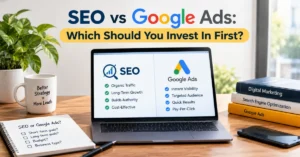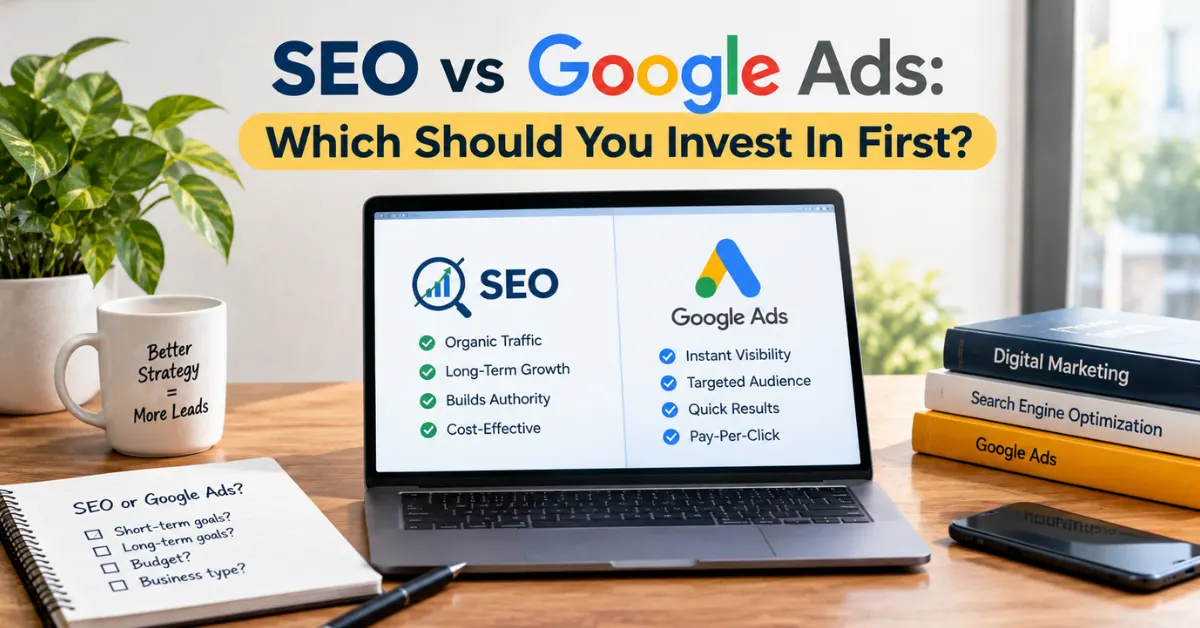


A client asked me last month: “Just tell me which one works SEO or Google Ads?” I get this question almost every week at HV Digital Marketing. And the honest answer isn’t the one people want to hear. There isn’t a single winner in the SEO vs Google Ads for lead generation debate there’s a right choice for your specific timeline, budget, and goal.
Quick Answer:
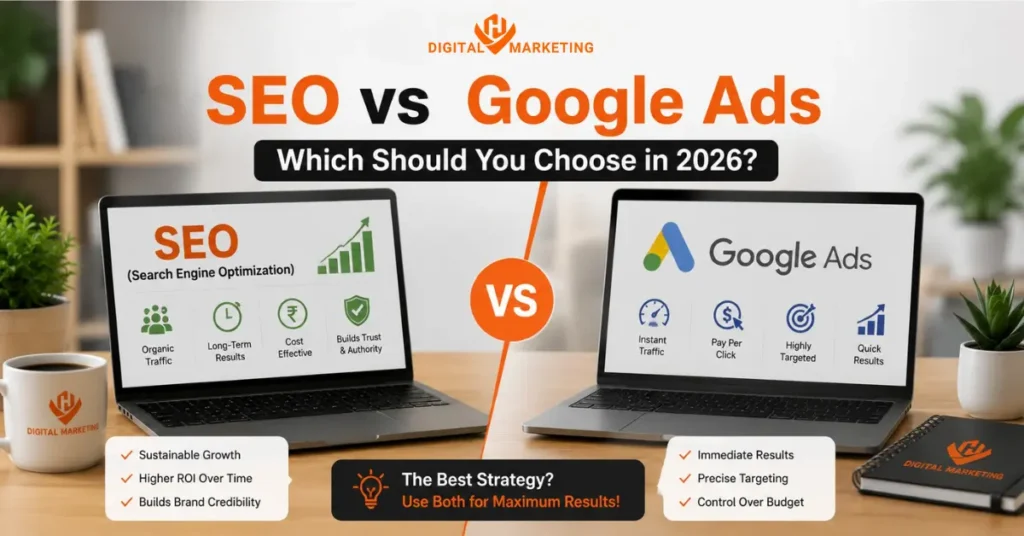
Google Ads generates leads within hours of launch but stops the moment you stop paying. SEO takes 3-6 months to show results but keeps generating leads without a daily spend. If you need leads this week, run Google Ads. If you’re building for the next three years, invest in SEO. Most businesses that grow fastest use both just not at the same budget split.
That’s the short version. Now let’s get into the actual numbers behind SEO vs Google Ads for lead generation, because “it depends” isn’t useful without data.
How SEO Works and Why It Takes Time
SEO search engine optimization is the process of improving your website so it ranks organically on Google for the terms your customers are actually searching. No daily ad spend. No auction. Just relevance, technical health, and content that answers what people are typing into the search bar.
Here’s the part nobody likes admitting: SEO is slow at the start. Painfully slow. When we take on a new SEO client in Surat, we tell them upfront expect 3 to 6 months before rankings move meaningfully for competitive keywords. That’s not a sales pitch. That’s just how Google’s indexing and trust-building process works.
But here’s why that wait is worth it. Once a page ranks, it keeps pulling in traffic without a per-click cost. Compare that to Google Ads for lead generation, where the tap shuts off the second your card gets declined.
In my experience, most small business owners underestimate how much SEO compounds. A blog post we wrote for a client in month one might barely register in month three. By month eight, it’s their highest-converting page. That’s not luck that’s how Google Search Central’s guidelines describe organic ranking: consistency and relevance win over time, not overnight tricks.
In the SEO vs Google Ads for lead generation equation, organic health matters as much as content volume. And here’s the thing SEO isn’t just blog posts. It’s technical fixes (site speed, mobile-friendliness), on-page optimization (title tags, headers, internal linking), and off-page signals (backlinks, citations, reviews). Skip any one of these and your SEO vs Google Ads comparison tilts hard toward paid, simply because your organic side isn’t firing on all cylinders.
How Google Ads Generate Immediate Leads
Google Ads is the opposite animal entirely. You bid on keywords, write an ad, set a budget, and by the afternoon sometimes within the hour you can have clicks landing on your site. For anyone weighing SEO vs Google Ads for lead generation on pure speed, PPC wins without argument.
Here’s what that actually costs in 2026. According to WordStream’s 2026 search advertising benchmarks, the average cost per click across all industries sits at $5.42, with an average cost per lead of $66.69. That number swings wildly by industry legal services can run $130+ per lead, while home services or automotive repair often land under $30.
This is the speed half of the SEO vs Google Ads for lead generation equation. So why does immediacy matter so much? Because if you’ve got a launch, a seasonal push, or a slow month, you can’t wait 4 months for SEO to catch up. Google Ads fills that gap. We manage Google Ads campaigns built around cost-per-lead targets not just impressions because impressions don’t pay your rent.
But and this is the part most PPC pitches skip the moment the budget stops, the leads stop. No residual traffic. No compounding. You’re renting visibility, not owning it.
Does that make Google Ads a bad investment? Not at all. It just means that in the SEO vs Google Ads for lead generation comparison, you’re paying for speed, not permanence.
Cost Comparison: SEO vs PPC Over 12 Months
Let’s run actual numbers, because this is where most SEO vs Google Ads for lead generation debates get vague.
Say a business spends ₹40,000/month (roughly $480) on Google Ads for a mid-competition local service keyword. At a $66 average cost per lead, that’s about 7 leads a month, consistently, for as long as the budget runs. Over 12 months, that’s ₹4.8 lakh spent for a steady, linear stream of leads no more, no less, unless you increase spend.
Now take SEO. The same ₹40,000/month invested in content, technical fixes, and local optimization might produce almost nothing in months 1-3. By month 6, maybe 3-4 organic leads a month. By month 12? For a well-optimized small business SEO strategy, it’s common to see that number climb to 10-15 leads a month and that traffic doesn’t disappear if you pause spending for a month.
This lines up with broader industry data. Analysis from BrightEdge and Searchmetrics found that SEO delivers roughly 5.3 times more traffic per dollar invested long-term, while Google Ads delivers results within 24 hours. That’s the entire SEO vs Google Ads for lead generation argument in one sentence: PPC wins on speed, SEO wins on cost-efficiency over time.
Here’s my honest take: I’ve had clients pull budget from Ads too early, expecting SEO to instantly fill the gap. It doesn’t work that way. Any real SEO vs Google Ads for lead generation transition needs overlap, not a hard switch.
Best Strategy Use Both Together
Most guides won’t tell you this straight, so I will: the “SEO vs Google Ads” framing is a little misleading. The businesses that grow fastest in Surat and beyond don’t pick one. They run both, in a deliberate mix.
The same industry research referenced above suggests an optimal channel mix of roughly 60% SEO and 40% paid search for most businesses though that ratio shifts depending on how competitive your industry is and how fast you need results. A dentist launching a new clinic needs Ads running from day one. A garment exporter with a 3-year runway can lean harder into SEO from the start.
Practically, here’s how we structure the SEO vs Google Ads for lead generation mix for clients:
- Run Google Ads immediately to generate leads while SEO builds.
- Track which keywords convert best in Ads use that data to prioritize SEO content targets.
- As organic rankings climb for a keyword, scale back ad spend on that exact term and redirect budget elsewhere.
The result is a lead pipeline that never fully depends on one channel.
This isn’t theory. We’ve applied this exact overlap model with clients pairing SEO and paid search, and it consistently outperforms an SEO-only or Ads-only approach within the first year.
And don’t ignore the third leg most people forget social proof and visibility through social media marketing feeds both channels. A well-reviewed, active social presence improves ad quality scores and gives organic content something to link to.
How to Calculate Your Cost-Per-Lead From SEO vs PPC
Want the actual formula instead of a vague benchmark? Here’s how we calculate it for clients comparing SEO vs Google Ads for lead generation side by side.
For Google Ads: Total monthly ad spend ÷ number of leads generated that month = cost per lead. Simple, and it updates in real time.
For SEO: Total monthly SEO investment (content, technical work, agency fees) ÷ number of organic leads that month = cost per lead. The catch you need at least 6 months of data before this number stabilizes, because early months will show an inflated cost per lead while rankings are still building.
Once you have both numbers side by side, month over month, the crossover point becomes obvious. That’s the month your SEO cost-per-lead drops below your Ads cost-per-lead and it’s usually somewhere between month 7 and month 12 for competitive local markets like Surat’s textile, diamond, or real estate sectors.
Examples From Real Client Work
We worked with a Surat-based home services client who was spending ₹35,000/month entirely on Google Ads with a cost per lead around ₹950. Within 5 months of layering in local SEO Google Business Profile optimization, city-specific landing pages, and review generation their blended cost per lead dropped to ₹610, because a third of their leads started coming from organic and Maps listings at near-zero marginal cost.
Another example: an e-commerce client running only SEO for 8 months had strong rankings but a thin lead pipeline during their off-season. Adding a modest Google Ads budget during that 6-week window filled the gap without disrupting their long-term organic growth.
Neither client “won” by picking one channel in the SEO vs Google Ads for lead generation debate. They won by sequencing both correctly.
Comparison Table: SEO vs Google Ads at a Glance
| Factor | SEO | Google Ads |
|---|---|---|
| Time to first leads | 3-6 months | Same day to 1 week |
| Cost model | Monthly investment, compounds | Pay-per-click, stops when spend stops |
| Long-term cost per lead | Decreases over time | Stays roughly flat |
| Best for | Long-term growth, brand authority | Launches, seasonal pushes, urgent gaps |
| Control over messaging | Moderate (algorithm-dependent) | High (instant edits) |
| Risk if paused | Rankings persist, slow decline | Leads stop immediately |
FAQs
Q: Which is cheaper SEO or Google Ads?
A: Google Ads costs less upfront but charges per lead indefinitely. SEO costs more early on but the cost per lead typically drops below Ads within 7-12 months, since organic traffic doesn’t require ongoing per-click payment.
Q: Can I run Google Ads and SEO at the same time?
A: Yes, and most fast-growing businesses do exactly that. Ads fill the immediate lead gap while SEO builds. As rankings improve for specific keywords, you can shift ad budget toward terms where you haven’t ranked yet.
Q: How fast do Google Ads generate leads?
A: Often within hours of campaign launch, assuming your landing page and targeting are set up correctly. Full optimization where cost per lead stabilizes usually takes 2-4 weeks of data and adjustments.
Q: Is SEO a long-term investment worth it?
A: For most local and service businesses, yes. SEO traffic compounds and doesn’t disappear when you pause spending, unlike paid ads. The tradeoff is a 3-6 month wait before results become meaningful.
Q: How do I calculate cost-per-lead for SEO vs PPC?
A: Divide total monthly spend on each channel by the number of leads it produced that month. For SEO, wait at least 6 months before trusting the number, since early-stage rankings understate true performance.
My Take
I’ve changed my mind on this over the years. When I started out, I pushed clients hard toward SEO because I believed in it as the “real” long-term play, and I’ll admit I undersold Ads. Then I watched a client burn through 4 months with zero leads because their industry was too competitive for organic alone to move fast enough. That changed how I advise people now.
The honest framework for SEO vs Google Ads for lead generation: if your business can survive a 4-6 month runway without new leads, weight toward SEO. If it can’t, start with Google Ads and layer SEO in behind it. Don’t force a channel because it sounds more “sustainable” on paper sustainability doesn’t pay bills in month two.
What this post doesn’t cover: the technical mechanics of keyword research, landing page conversion optimization, or how to structure Performance Max campaigns. Those deserve their own guides.
Not sure which to choose? Get a free consultation from HV Digital Marketing to plan the right strategy for your goals. If you want a deeper look at how we approach organic growth first, read our guide on SEO services in Surat.

Founder of Digi Segment and HV Digital Marketing
SEO Strategist & Digital Marketing Expert
Hardik Vaghani is a digital marketing professional and SEO strategist based in Surat, Gujarat, India. He is the founder of Digi Segment, a content and insights platform covering SEO, digital marketing, AI tools, and online growth strategies, and the founder of HV Digital Marketing, a results-focused digital marketing agency helping local and service-based businesses rank on Google and generate consistent leads.
With hands-on experience in Search Engine Optimisation, Technical SEO, Google Ads, Meta Ads, and Content Strategy, Hardik has helped businesses across industries including e-commerce, real estate, healthcare, home improvement, and solar companies improve their organic visibility, local search rankings, and lead generation through ethical, white-hat strategies.
He specialises in Core Web Vitals optimisation, on-page SEO, keyword research aligned with search intent, and building scalable content frameworks that rank. At Digi Segment, Hardik shares practical, experience-backed insights, case studies, and step-by-step guides to help marketers, entrepreneurs, and small businesses grow online.
When he is not optimising websites, Hardik is building digital tools, writing SEO-focused content, and working with his agency clients to turn Google visibility into measurable business growth.
Expertise: SEO | Technical SEO | Google Ads | Meta Ads | Content Strategy | Core Web Vitals | WordPress | Digital Marketing | Lead Generation | Local SEO